Most League players believe that their KDA (Kills, Deaths, Assists), and damage dealt are some of the best stats to measure a player’s performance. However, these types of statistics are not consistent in displaying a player’s overall impact within a game. My goal with this article is to help players understand that although there is no perfect way to display performance within a game, we can use better in-game statistics to help evaluate player effectiveness.
Part 1: Misinterpreted Stats
KDA
KDA (Kills, Deaths, Assists) is a metric players use in League and other games to determine their overall impact on a game. The best statline is having high kills and assists with as few deaths as possible. However, KDA is a very misconstrued stat that oftentimes does not tell the full story on how a game played out.
For example, a player might have a negative KDA (more deaths than kills), however they secured every tower and the team won because of their split pushing ability. Maybe an engage support is 0/10 but had the game-winning hook at the end of the game that secured their team Baron/Elder. Or maybe a player went 10/0 and destroyed their opponent in lane but then didn’t translate their lead to the rest of the map, while their opponent grouped for important objectives. The point being proven is that KDA is an overrated statistic that players will use to point blame, and there are better metrics to assess player impact.
Damage Dealt to Champions
Damage dealt to Champions is another extremely misused statistic that players use to evaluate performance. Damage to Champions accounts for all the damage you did to the opponent. The issue is that some Champions inherently do more damage than others, and damage doesn’t always directly contribute to winning.
For example, a Karthus will almost always have the most damage at the end of a game because his ultimate hits 5 different people and his only purpose is to deal Champion damage. Another example could be a Galio mid lane, who barely did any damage but helped support his team in critical fights with his ultimate and crowd control. Players will oftentimes click the damage charts and start pointing blame to whoever dealt the least damage (excluding the support), however this is not the correct approach to evaluating performance.
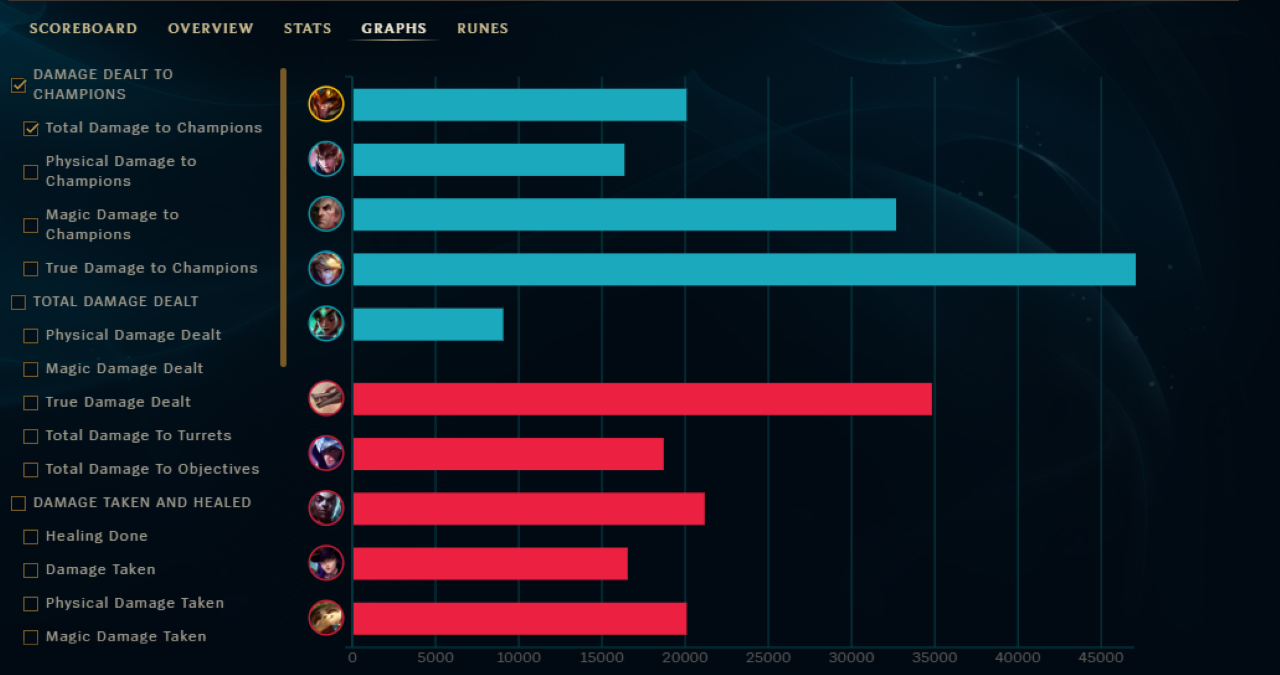
Looking at the chart below, the Jarvan in this example has around the same amount of damage as the enemy talon. However, in this match, the Jarvan ganked bot multiple times and helped snowball his Ezreal and secured all the Dragons, showcasing how damage dealt was not the main reason for the blue team's victory.
Vision Score
Vision score is another controversial stat in terms of its significance within a game. It can be argued that a high vision score indicates a player was very active with warding and helped deny enemy vision. However, the statistic fails to account for a very important concept; the impact of your wards. Vision score simply measures the activity of a player’s vision, not the quality.
For example, if a player secured vision for their team through placing and clearing wards around an objective 30 seconds before it spawned, that would be considered meaningful. However, if a player is simply spamming wards in random bushes to get their vision score up, that’s entirely different. Vision score also rewards supports disproportionately from the other roles because of their access to multiple wards. Overall, the statistic is nuanced because it rewards quantity of vision over quality, however placing more wards can still have its use.
Part 2: Key Performance Indicators Within League
Creep Score (CS)
Creep Score (CS) is a statistic in League that measures how many minions/jungle camps a player has taken throughout the game. High CS indicates that a player was able to secure gold and experience for themselves and understands how to maximize their resources. The golden number for CS is about 10 per minute, which is what most players strive to accomplish during the laning phase and onwards. For junglers and especially supports, CS will usually be lower than laners because these roles prioritize objectives and vision control over farming for themselves.
CS is a great indicator for performance because it reflects how effective a player was in securing resources throughout the game. The gold and experience from farming minions at a high level translates into earlier item power spikes and overall strength. Low CS indicates a player was inefficient and either missed multiple minion waves or was unable to last hit consistently.
Objectives Secured
Another great stat to measure performance is objectives secured throughout a game. Objectives include Dragons, Grubs, Rift Herald, Towers, and Inhibitors. For junglers, the neutral objectives would be more relevant, and for laners, the towers/tower platings are more significant. The way to figure out objectives taken is to simply download the replay of a game and scroll to where each objective was secured. Look 30 seconds before and see where everyone was located. Did you have lane priority, did you have teleport and instead chose to push, did you secure vision control of the area before entering?
All these questions help determine which team secured the objective and how a player could have influenced the situation. Control around objectives is a difficult stat to evaluate simply by looking at the box score, and it requires more in-depth analysis and understanding. However, objectives are key to winning a game, and it’s important to recognize the impact of not getting caught before important objectives, having side lanes pushed, and establishing vision control in these scenarios.
Gold Difference at 15 Minutes
Gold difference indicates the gap between a player’s gold and their opponents at a certain time frame. The early game and laning phase typically end around 15 minutes, which is a good checkpoint to assess a player's performance.
To find this statistic, simply go to match history within the League client and click on overview. There you can access each player's gold graph and compare yours to the opponents. If you’re consistently earning more gold than your opponent each game, that indicates your early game pre-15 minutes is great. You either farm well, secure early kills or towers, or know how to put the opponent behind through denying them resources. Although the stat does not account for certain nuances such as jungle ganks or skirmishes, it’s an easy way to recognize a player’s early game activity.
Conclusion
Players use various statistics to help evaluate their overall impact within a League game. Metrics such as KDA, damage dealt, and vision score do have some value; however, they don’t properly account for the nuances of the game. Creep score, gold difference, and objectives secured are much better indicators for evaluation because they directly translate to winning and better display a player’s consistency. I hope you can use the knowledge from this article to look beyond surface-level stats and evaluate performance through metrics that truly reflect impact, consistency, and contribution to winning games.