When you think of Rocket League mechanics/skills, the first ones that come to mind are likely extravagant highlights such as flip resets, ceiling shots, redirects, etc. But what if there was one aspect of Rocket League that pro players and coaches alike would agree is more important than any other ability out there? You might be surprised to learn that there is. The skill that nobody talks about, yet is agreed to be one of the most important foundations, is the ability to recover.
Recoveries in Rocket League are far more fundamental than flashy mechanics. In order to even make it to high-level lobbies, one needs to have a master level of car control so that they can get back into the play and carry momentum. Anybody can press boost and flip, but it takes a true expert to be able to recover and maintain momentum from any situation while others get stuck coming to a halt and needing to re-accelerate.
What Are Recoveries?
Recoveries are not just about landing on your wheels. Recoveries can be more acutely defined as regaining control and getting back into the play. Everyone finds themselves recovering several times a game. Recoveries generally take place after going for aerial shots, 50/50s, saves, bumps, etc. Instead of landing on the top or side of your car, land on your wheels while maintaining momentum. That last part is just as important as landing on the wheels.
A good way to maintain momentum is to hold the powerslide even if you are facing the direction you need to go. In most recovery situations, some minor corrections need to be made to one’s car. Usually, Wave Dashes, Half-Flips, and Powersliding are enough. For the skillful students, there are more creative ways to recover more efficiently, which we will get into later.
Why Recoveries Matter
If it isn't clear already, recoveries are important for a variety of reasons. One of the overlooked reasons is that it is a major boost saver. When you are saving boost, not only do you have that resource if the need arises, you also spend less time going for boost, meaning less time you are not involved in a play. Furthermore, you are spending less time accelerating to go supersonic. If you can keep your supersonic speed (when your wheels have a trail behind them), you are actually saving 35 boost as well as the roughly three-quarters of a second it takes to get there. Recoveries are also important for less obvious reasons.
For example, you go for a challenge to make your opponent less comfortable with the ball. When you inevitably 50/50 the ball, you may need to follow up your challenge depending on the result of the 50/50 and your teammates' positioning.
Recovery Techniques
Now it’s time to get into the good stuff. Some of you may be wondering, how else can you recover other than simply landing on four wheels and using powerslide? You’ll be happy to know that there are several ways to recover that will give you the edge next time you go play Rocket League.
First, we’ll talk about the more obvious ones. Evidently, you’ll typically want to land on all four wheels, and depending on the situation, you may want to hold whatever button you have powerslide bound to. Because powerslide doesn't take momentum even when holding boost/accelerate, you’ll want to hold this button 99% of the time during recoveries. The reason you want to powerslide in most situations is that it allows your car to drift. When you are drifting instead of coming to a complete stop, you are maintaining some momentum. Usually, you'll want to follow this up with a correction flip so that you are facing the correct direction. This drift into a flip is also a great way to generate more speed without using boost.
Secondly, most of you are already practicing this, which is using Half-Flips. Half-Flips are a low-difficulty mechanic that allows your car to make a full 180-degree turn without wasting time by driving in a half circle or drifting. To perform a Half-Flip, you backflip, cancel halfway through, and rotate your car so it is not “belly up”. This will allow the nose of your car to face the complete opposite direction from before. It may sound daunting to new players, but this is a very simple mechanic that does a world of wonders for your game with only five minutes of practice. My favorite tutorial of the Half-Flip comes from RLCS World Champion SquishyMuffinz. His video tutorial of the Half-Flip will be linked here. Once you have that down and can incorporate boosting into your Half-Flip, you will start to notice how much you can outpace your opponents.
Next is another mechanic that most people know how to do, but might not be using it to its full potential: the Wave Dash. Again, for those who do not know, Wave Dashes are a flip that is performed just before a pair of wheels (left, right, front, or back) hits the ground while the opposite pair is on the ground. Doing this, usually whilst holding the powerslide button, results in the car accelerating faster than just driving. This is because the car’s power comes from the flip, pushing forward and into the ground, rather than the whole animation flip needing to take place. The best time to use a Wave Dash whilst in a recovery is when you get bumped, jumping from the wall to the ground, falling from the ceiling, or on the rare post Flip-Reset attempt where you did not use the flip.
A less commonly known recovery technique is to point your car’s nose down toward the ground when you are flying into a wall. For example, let’s say you went to challenge the opponent on their half of the field. After the challenge, you often find yourself falling near the crevice of the wall. When this is happening, whether near the crevice or sometimes even higher on the wall, you should point your nose down towards the ground or sometimes facing the direction you want to go next. This is because when you do not do this, it takes significantly longer to recover by Wave Dashing at least twice to get down and then face the correct direction. Or even worse, you may need to turn your car around the old-fashioned way by driving in a semi-circle. Even using powerslide while facing up is significantly slower than landing facing down whenever possible.
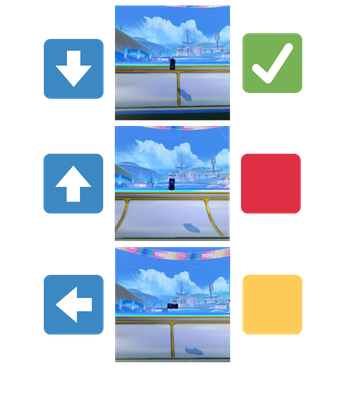
When put into practice, you can tell a significant difference in recovery speed and preparedness. It is Rocket League’s definition of “Hitting the ground running.”
Lastly, an idea overlooked by new players and veterans alike is using boost in order to get to the ground quicker. Say you go for a challenge, and afterwards you find yourself falling slowly back to the ground. Instead of waiting patiently, make sure to use boost to get back to the ground and get you back in the game quicker. Everything is about urgency in high-level lobbies.
How to practice
The best way to practice these recoveries is to go into freeplay and practice each technique til you have mastered them. Then, still in freeplay, you are going to want to challenge the ball as fast as you can and as hard as you can. Disregard aim, just hit the ball as hard as you can, as quickly as you can. Make sure to focus on your recoveries after you hit the ball. Incorporate all techniques to the best of their abilities. You will soon find yourself recovering faster than everyone else in your lobbies and outpacing the competition.
Conclusion
Although not the flashiest of mechanics, recoveries are definitely the unsung heroes of reaching high levels of Rocket League. Without decent recoveries, it is impossible to reach the high ranks of Rocket League because it is such a detriment to one’s speed. Recoveries alone will not land you on the front page of the Rocket League subreddit, but they are a vital foundation for anyone looking to reach that next level. Despite seemingly minuscule, make sure to pay attention to recoveries next time you watch RLCS. You will start to notice just how important they are to one’s gameplay and how surprisingly often they occur.