Understanding League of Legends’ Fake Z Axis and Hitboxes
A look at how terrain effects skillshots on the Rift.
A look at how terrain effects skillshots on the Rift.
In League of Legends, one of the most important things to learn is hitting your skillshots. Whether you’re a squishy mage sitting mid, a battle-hardened bruiser in top, or even a heal-heavy enchanter down bot, making sure that you can actually get your skills to hit the enemy is a key component to all phases of the game. It seems simple enough, right? Just point the cursor at the enemy (or even better, where they are heading) and let the skillshot fly. If you play with skill indicators on, it may not be so straight forward.
Your plan for rooting that enemy with Morgana’s Q or Ahri’s Charm might seem foolproof… but sometimes, the real position of your enemy isn’t where they seem to be at. Summoner’s Rift has a flat map, but uses three-dimensional graphics on the terrain and Champion models to breathe life into the visual
League of Legends is played on a two-dimensional map. Champions in this game can only really move on two axes: forward/backward (Y/vertical) and left to right (X/horizontal). They can move diagonally, but that is just treated as a combination of two of those options happening at the same time. What Champions can’t do is move up vertically. The map is a flat surface, even though the terrain and 3D-modeled Champions might make it seem otherwise.
League of Legends has graphics that are created in three dimensions, which make them look a lot more realistic. Characters, units, and terrain are all graphics rendered in 3D. They are still placed on the same flat surface. These interactions can be tricky if you don’t know what to look for or if you’re still learning the basics.
Despite the game being on a flat map, players can see Champions up in the air in a number of cases. Characters in game may get knocked into the air by some forms of crowd control, or may jump into the air with skills like Tristana’s Rocket Jump. It might seem like these people are higher off the ground than other Champions, but don’t be tricked! The hitbox for each Champion will stay where they were on the ground, instead of high in the air.
When a Champion gets hit by abilities that knock up, the character model goes flying. New players might think that the character is actually sent higher above the ground than the rest of the players. That seems like the obvious answer, but the reality is that their hitbox stays on the ground.
While Champions may appear in the air, they are not actually sent flying. Their model floats above the 2D map, but the hitbox (what lets your abilities interact with the enemy) is still in the same spot, level on the ground. Remember that the map itself is a two-dimensional grid at best, and any elevation that seems to be there is not real. If you are Morgana trying to hit a Dark Binding on a knocked up target, you will want to make sure to point your cursor where they were (their position on the ground) instead of where they “are” (in the air).
The terrain in League of Legends looks like it has lots of highs and lows. Like we mentioned earlier, though, these visual height differences are not real. You are always effectively on even ground with the enemy, but the three-dimensional models used for the game’s graphics can play tricks on your eyes. The character model appearing to be on higher ground than you should be thought of more as an optical illusion instead of reality.
In this case, Senna looks like she is pointing her Last Embrace right at the enemy training dummy. The indicator is lined up with the middle landing directly in the center of its head, so it looks like it would hit.
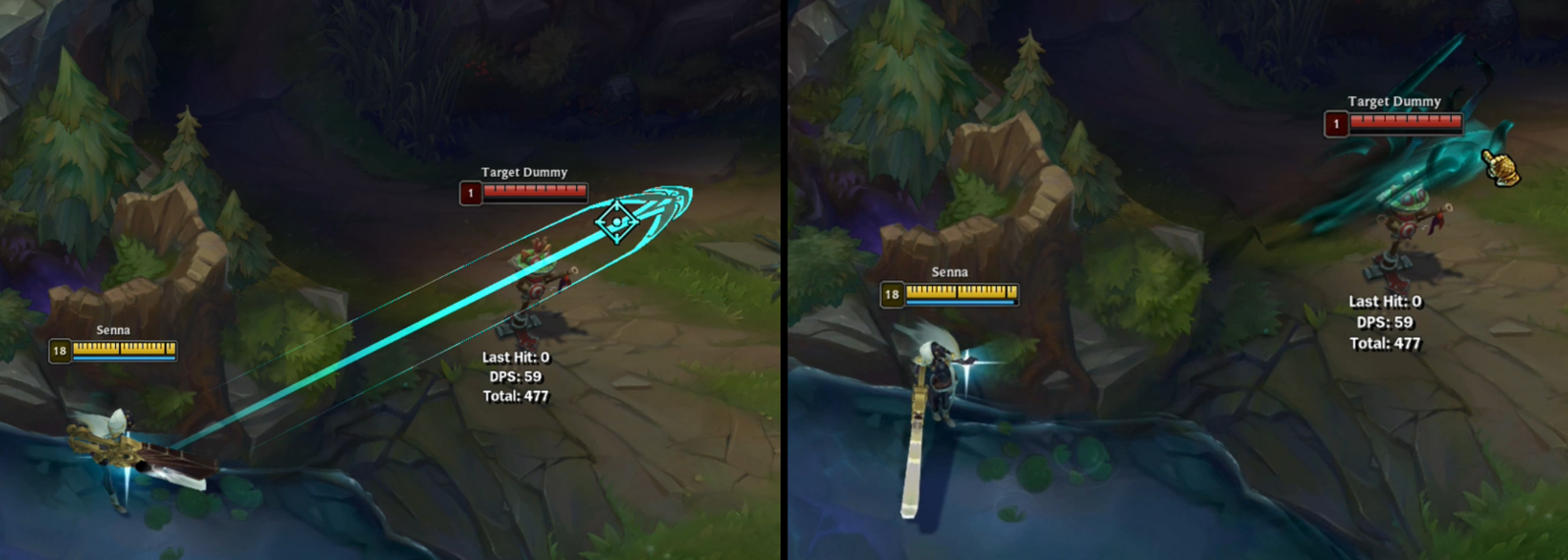
In practice, hovering the indicator over the top half of the Champion on “higher ground” will not hit as often.
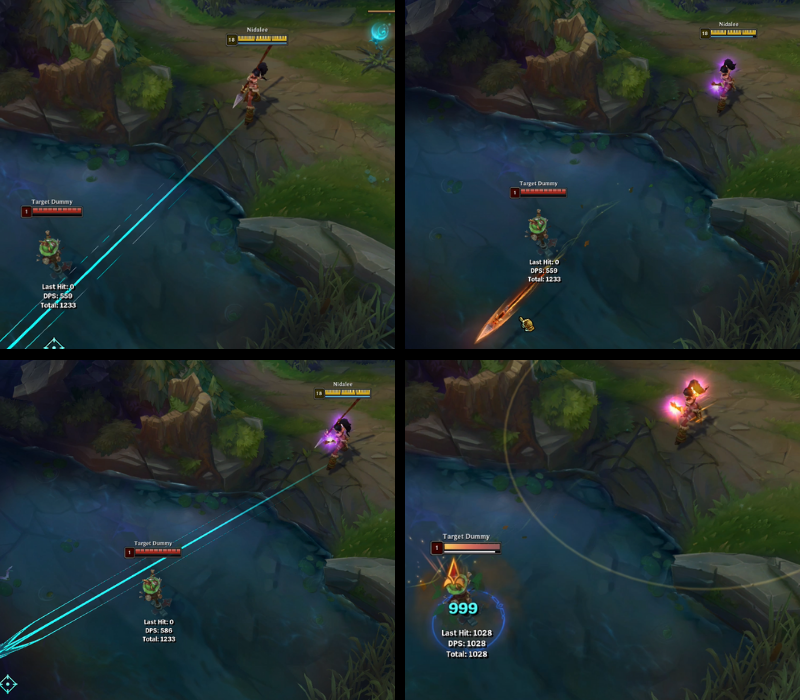
The river appears to be lower ground, so aiming over the center of the character model would normally be the right move, but the hitbox is still grounded on where the enemy Champion is standing. Senna has a pretty generous hitbox on her W, but looking at a narrower ability makes this much clearer.
An easy way to remember how to hit from “lower ground” is to aim for the character’s legs. Focus on where the enemy is standing, rather than the top of their character model. While you can hit skillshots aiming high from below, League is much more forgiving if you follow that rule. Look at how far below the target Nidalee is aiming; she still hits!
If you are standing on the “high ground” and aiming at someone “below” you, do the opposite! If you are on high ground, shoot for their head (or above) rather than below. The hitboxes are a lot more forgiving this way. There’s a lot more wiggle room on the upper half of the character model when we’re on high ground:
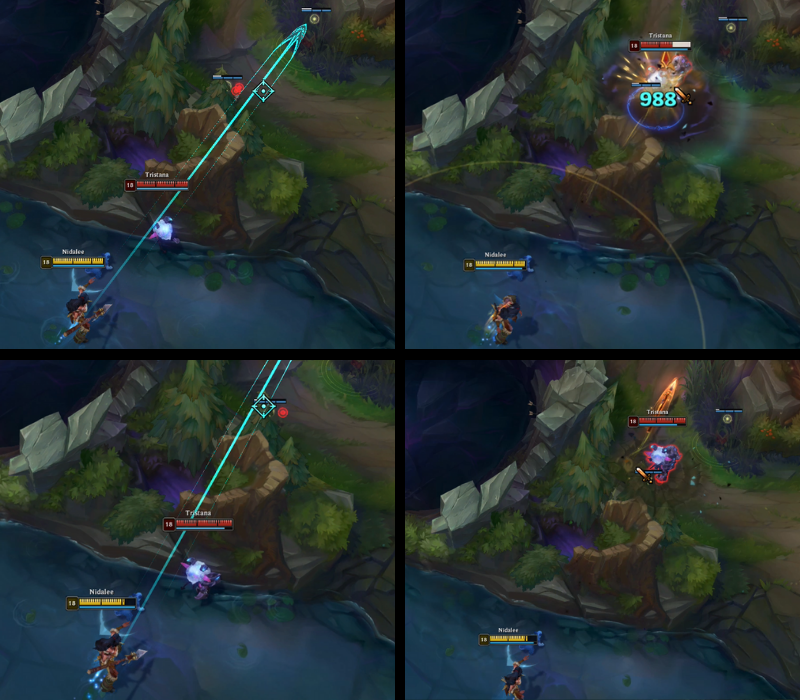
Certain terrain is almost impossible to go over, unless your Champion has a jumping ability. Instead of viewing terrain walls as raised areas on the map, think of them more like spaces that are blocked off or out of bounds. Your character can’t step on those squares in the map’s grid. With that in mind, aim where the enemy would be if they walked across the impassable terrain. Here are some examples with Tristana jumping over the wall. We don’t want to aim up as they jump up. Instead, aim through the wall.
When Nidalee throws her spear above Tristana’s standing position, even slightly, it will miss. If she throws it directly where Tristana is standing, or as if the wall did not exist, it will hit. See the example here:
Focusing on Champion position may be a lot for you to think about if you have not gotten used to the concept of terrain. As you play League of Legends more and get more familiar with your Champion’s abilities, this will all start to come naturally! You will learn to predict movement and understand what will hit, or what is likely to miss. While studying positions can be helpful when you’re starting out, nothing will beat time spent practicing against real players.