How to Use Rocket League Replays Like a Pro
Learn these quick tips to analyze replays like Rocket League pros instantly.
Learn these quick tips to analyze replays like Rocket League pros instantly.
As most of us know, the Watch Replay feature on Rocket League can be very useful for saving our highlight reel plays and amazing 0-second goals. However, almost all players do not utilize the replay feature as the necessary tool that they should be.
For the veterans of Rocket League, we have been told a million times to watch our replays, but we are never taught how to watch them properly. I know what most of you are thinking, and I’ll be the first to admit this out loud: sometimes watching replays can be boring and mundane. Shocker! We just want to play the game and queue for the next game as soon as ours finishes. Believe me, I know. This is why I do not approach the subject of analyzing replays lightly. Plus, learning how to properly examine my replays has turned it into a fun activity rather than a tedious chore I must do in order to climb the ranks.
If stepping up to the next level is something you are serious about, you need to read this guide and apply it to your training.
What a lot of upcoming players do not realize until they’ve already slaved hundreds of hours into the game is that decision-making and pattern recognition are just as, if not more, important than fancy mechanics. Now don’t get it twisted, mechanics are a crucial element to the game that are not avoidable to achieve higher ranks. But replays can give you more insight into your mechanical shortcomings than you realize.
Replays allow you to see why you are out of position, why you are missing shots, or why you are losing challenges. Another thing replays add to your toolbox is pattern recognition. When you see yourself in a situation a couple of times, you are more likely to react more favorably in the future or completely avoid the situation next time if the situation could have been avoided in the first place.
Now that we have it hammered down on why we need to watch replays, now is time to note your shortcomings. Here are the most common mistakes players make and example questions that pertain to those mistakes.
Positioning & Rotations
Boost Management
Challenges
Decision-Making
Obviously, there are more mistakes than the ones listed above, but hopefully you remember these examples listed above or can use them for inspiration. Furthermore, it is important not to over-analyze. Ways to do this are to focus on one aspect at a time. For example, do a boost-only replay or positioning-only review.
When having an analysis session, it is crucial to keep in mind not to just watch your own POV. First, watch from your perspective, then a teammate's, then an opponent's. If you still feel there is more to learn from the same replay, perhaps even watch it from Free Cam. There is an external website that is fantastic for watching replays from an isometric view. I will go more into this amazing tool later.
Whilst watching these replays, make sure to note the mistakes you are watching out for and timestamp them. This can help you to have a better grasp of your most common mistakes, so you know what skills to train more attentively.
Another tip for analyzing like a pro is to watch the pros. There is a lot to learn from pro gameplay, even if you are lightyears from their skill level. Now, don’t just grab a drink, pop some popcorn, and kick your feet up. That is what spectators do. We are students of the game. Those who watch replays as spectators are not just wasting their time; they are hurting their game. Even the highest-level players and coaches are not masters of the game, and watch fellow pro players and especially pros who have a higher skill level than they currently possess. They themselves will tell you firsthand that they are students of the game. To be a student means to ask questions.
Using a What, Why, How framework, we can become more astute students when analyzing high-level Rocket League games. Every so often, hit the pause button and frame your questions like so: “What is the player with the ball doing?” “Why are they doing it this particular way?” “How would I react in the same situation?” Structuring our analysis such as this way allows for a more in-depth understanding of the niches we would not be able to appreciate as spectators. One of my favorite ways to watch replays is to observe a specific player. Although I would study my favorite players some of the time, I would spend most of my time analyzing players that had similar play styles to myself, even if they weren’t one of the top teams.
One of my favorite external resources is called ballchasing.com. Here, you can upload your replays, as well as watch pro games from an isometric view or with a birds-eye view. This website is incredibly helpful as it also breaks down statistics such as field positioning, boost, and ball control by player. My favorite part, though, is using the website to download pro matches and put them into my own replay folder to watch in-game. This allows me to truly have everyone's perspective in the game as opposed to watching past broadcasts where POV is sporadically changed and is limited.
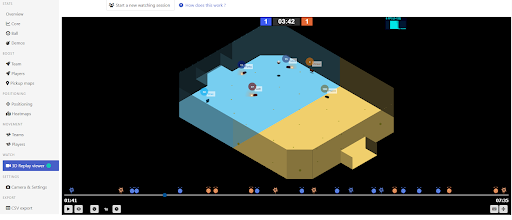
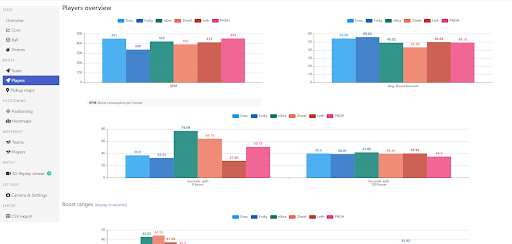
Screenshots taken from BallChasing.com
Most players instantly “rage queue” into their next match after a bad loss due to some situation out of their control such as “bad teammates”. Perhaps that is the perfect time to analyze your replays. Although you sometimes prove yourself right, it is important to approach the analysis from a student’s perspective and do your best to eliminate all biases. Remember to take notes, ask yourself questions, and analyze like a pro!