The 15th season of the Rocket League Championship Series (RLCS) is back, and today we’ll break down everything you need to know to follow it as closely as possible. This season is structured around six (6) open events and four (4) Major LAN events.
Major LAN Events
- Kickoff LAN in Copenhagen, Denmark - December 7, 2025
- Boston Major - February 19, 2026
- Paris Major - May 20, 2026
- RLCS World Championship - September 15, 2026
Region Breakdown
The regional structure looks a little different this year compared to seasons past. There are still seven (7) participating regions: Europe (EU), North America (NA), South America (SAM), Oceania (OCE), Middle East & North Africa (MENA), Asia-Pacific (APAC), and Sub-Saharan Africa (SSA). However, the rules for participation have changed significantly.
Starting this season, at least two of a team’s three players must live in the region they are competing in. This change eliminates situations where players compete on high ping from outside their designated region.
Each region sends a set number of teams to the Major LANs based on regional performance from the previous season. The breakdown is as follows:
- Europe (EU) - 4 teams
- North America (NA) - 4 teams
- South America (SAM) - 2 teams
- Middle East & North Africa (MENA) - 2 teams
- Asia-Pacific (APAC) - 1 team
- Oceania (OCE) - 1 team
- Sub-Saharan Africa (SSA) - 1 team
This adds up to 15 teams per Major. However, each Major features 16 teams, so where does the final spot come from?
The Kickoff LAN Explained
As mentioned earlier, the season begins with six open events, with the first leading into the brand-new Kickoff LAN in Copenhagen, Denmark. This event played a crucial role in determining Major qualification.
The Kickoff LAN featured the top six teams from North America and Europe from Open Event 1. These teams faced off to decide which region earns an additional spot at the remaining three major LANs.
In the Grand Finals, Karmine Corp (Vatira, Atow, Juicy) defeated Shopify Rebellion (FirstKiller, LJ, Kofyr) in a dominant 4 - 0 sweep. With that victory, Europe secured the coveted fifth spot at all three remaining Majors.
Image Source: Liquipedia
The Regionals
The stage is set, and each region now knows how many teams they’ll be sending. From there, the open qualifiers determine exactly which teams earn those spots. Each open qualifier is separated into four stages.
Stage One: Open Bracket
In Stage One, over 1,000 teams enter a double-elimination tournament. From this field, only the top 32 teams in each region advance.
Stage Two: Swiss Stage
Those 32 teams move on to the Swiss Stage, which is split into two groups of 16. Each group functions as a triple-elimination format. Win three matches and you advance, lose three matches and you’re eliminated. From each group, eight teams move on to the next stage. Unfortunately, Dignitas was eliminated during the Open 1 Swiss Stage, but we’re hopeful they’ll bounce back in Open 2.
Stage Three: Group Stage
The remaining teams enter the Group Stage, where they are seeded based on their Swiss performance. Teams are split into two groups that operate as double-elimination brackets. Four teams advance to the playoffs from the winners side, while four more qualify through the losers side.
Stage Four: Playoffs
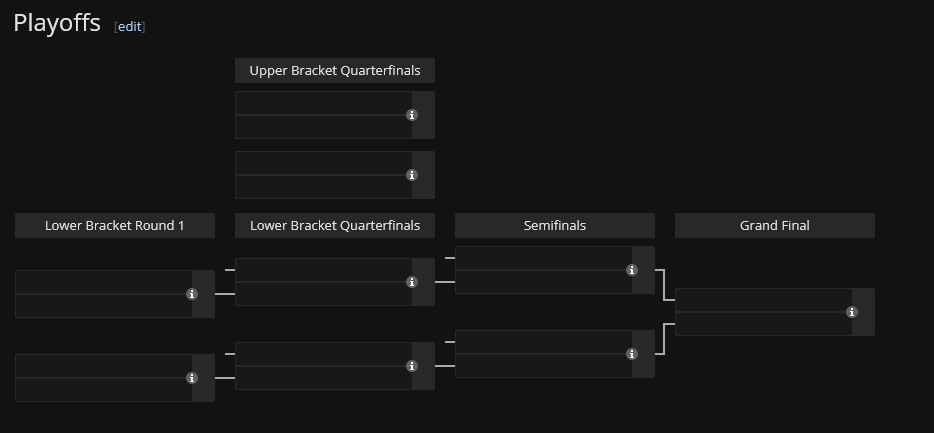
The final stage is the playoffs. We start in the upper-bracket quarterfinals, where the four teams advancing from the winners side of groups face off to determine who reaches the semifinals. The two losing teams drop into the lower-bracket quarterfinals, where they meet the winners from the losers-side matchups.
From there, the bracket plays out until the grand finals, where teams compete for a share of the $133,200 prize pool awarded at each open, along with crucial points toward World Championship qualification.
Image Source: Liquipedia
Point Distribution per Open Qualifier
- 15 points - 1st place
- 10 points - 2nd place
- 7 points - 3rd–4th
- 5 points - 5th–6th
- 3 points – 7th–8th
- 2 points – 9th–12th
- 1 point – 13th–16th
After three open qualifiers, the teams with the most points in each region qualify for their respective Majors. In the event of a tie, the tied teams will face off in a best-of-seven (Bo7) tiebreaker match to determine who advances.
These points are then banked toward the World Championship rankings, alongside any points earned at the Boston Major.
The Boston Major & The Paris Major
The Boston Major is technically the second Major of the 2026 circuit, but the first to feature all seven regions. It will be held at Agganis Arena at Boston University and boasts a $354,000 prize pool, slightly higher than last year’s Birmingham Major.
Majors are adopting a new format this season. Instead of starting with a Swiss Stage, the 16 qualified teams are divided into four groups. Each group plays a round-robin format, similar to the FIFA World Cup. The top two teams from each group advance to the playoffs: the group winner moves to the winners quarterfinals, while the second-place team starts in round one of the lower bracket. From there, the playoff format mirrors that of the open qualifiers.
The second Major of the year is slightly different. There are more world championship points on the line and three teams from each group, instead of two, will advance to the playoffs.
The World Championship
Returning for RLCS 2026 are the Last Chance Qualifiers. The four regions with the strongest performances throughout the season will earn an additional World Championship spot. These spots are determined through a seventh open qualifier, with the winners claiming the final four berths.
The World Championship itself is divided into three stages. It begins with the Play-In, where the teams seeded 13 through 20 compete in an eight-team double-elimination bracket. The top four teams advance to the Group Stage, while the rest go home.
After the Play-In, the tournament follows the same format as the Paris Major, continuing through the playoffs until a world champion is crowned on September 20, 2026.
Other Formats
The 1v1 World Championship returns, and this time it’s joined by a new 2v2 game mode that will follow the same competitive format. Qualifiers for both events will take place after the second Major, with the top four players and teams advancing to a single-elimination tournament to crown the 1v1 and 2v2 champions during World Championship weekend.
Conclusion
Rocket League continues to evolve each year, and the RLCS circuit this season will be just as exciting as ever. Will NRG repeat as champions, or will a new contender rise up? We can’t wait to find out.